Thursday, August 22, 2013

Re-Unity in Travel

I have just completed two weeks of almost non-stop action. An underlying rule that guides this saga (and just about everything here) is that even the simplest of travel plans in Indonesia turn into an epic tale.

All of the IACS participants had a holiday for some portion of the past two weeks following Ramadan. This was to allow for Idul Fitri, a Muslim holiday period of celebration and forgiveness. We were free to explore anywhere in Indonesia on our own terms.

For most of my first two months I had waffled on where to go and with whom I would travel. Two weeks prior to vacation, I booked a first class train ticket ($18) to Bali. It was the last available, finally forcing me to make a decision.  From there I decided to meet in Ubud with Yan from Bulgaria and Ana from Serbia as they toured the island by motorbike. This covered my first two days. Everything after was almost entirely on the fly.

Haylee (from Australia) and I took the overnight train from Surabaya to Banyuwangi, the eastern tip of Java (“The Sunrise of Java” according to the tourism board). There, we go onto a bus that got onto a ferry which shuttled us across the Bali Sea onto the mythical island, then four hours later we ended up in Denpasar, Bali’s capital. Our booked ticket ended here, and at this point we had to find our way to Ubud with our trust in a bemo (minibus) driver. They’re not particularly trustworthy.

I had looked up information on a cheap way to get there, and plenty of websites had claimed that there were public minibuses for about 8000 rupiah (or $.80) up to Ubud. We couldn’t find them. This is because in Indonesian bus or ferry terminals (on all islands, it seems), there is a wall of transport hawkers greeting every vehicle, looking to cheat any unknowing travelers with ridiculous prices. Since Haylee and I were the only tall and white people there, we became a prime target. Eventually we negotiated one down to 50,000 each. Ten times what it should be, but the best we were going to get.

No matter, we were in Bali! And it’s so green! It seems like every road in Bali is post-card perfect. Even the grey afternoon mist was picturesque as it hung over the alternating rice paddies and plantations cut into the rainforest. We marveled at this for about an hour, and then we knew we had reached Ubud when the traffic reached a complete standstill on the narrow jungle street.
Green! Photo by Haylee

Many consider the town to be the cultural and artistic capital of Bali, so it is also a major bule hub, especially since Julia Roberts showcased it in “Eat, Pray, Love.” Therefore, rental cars, tourist busses and motorbikes choke the tiny roads of what used to be a tiny collection of villages. And wow, there are so many white people there. It had been awhile since I saw such a concentration, and I caught myself staring like many Indonesians do when I walk around Surabaya.

Haylee and I parted ways in front of the village’s Monkey Forest, which is exactly what it sounds like. After immersing myself into Balinese culture with a pizza and a beer, I set out into the intermittent drizzle to find the hotel that Yan had booked. Unfortunately, Indonesian roads, just like in DC, are incredibly confusing, ending in one place and restarting (or duplicating, in this case) illogically somewhere else. As a result, I wandered up and down the hotel’s supposed road for about two hours, asking everybody how to find a seemingly non-existent home stay. While not helpful (nobody had heard of this home stay), the strangers I approached were very eager to help, and even wanted to converse with me (because I can use basic Bahasa Indonesia now), but I was too desperate and confused to stick around.

Thankfully, I eventually stumbled upon the right shopkeeper who pointed me up a side road, and the gathering panic in my chest quickly dispelled as the fragmented directions of dozens of friendly people finally coalesced into coherent directions and I found my destination.

This is a good lesson for over-packers: you never know when you’ll wander through winding rainforest lanes looking for your hotel. Pack light!

Yan and Ana, suffering the same disorientation as myself, arrived just after me, and we finally reunited after two months in our separate arts centers. Despite only having a week together in Jakarta, it was like greeting old friends with the warm hugs and the excited shouting of a new opportunity to be with each other.

We quickly caught up with each other in the room, and then set out in search of our Dutch friends, Maaike and Dewie, before attending a Balinese dance performance. All three of us squeezed onto one motorbike (the suspension was not happy) and took a shortcut past the Monkey Forest into town.

Side story: Had I taken this path, I would have found the home stay within fifteen minutes, but the locals warned me not to go through, because the bag of fruit I was carrying would have guaranteed a mugging by the gangs of primates eyeing the passing visitors from their perches on the fence. The monkeys make you feel like you wandered into the wrong neighborhood in the city.

At the performance (where we scored a discount with our IACS ID cards), we got to sit next to the gamelan players on the stage. It was such a beautiful show; the energy of the music and dancing has a very spiritual aspect, which I eventually noticed pervades just about every aspect of Balinese life. The costumes’ powerful colors, the dancers’ penetrating stares and the music’s rapid polyrhythm were almost trance-like. I quickly lost myself in the beat and the movements, and was fairly upset when it ended two hours later.

It’s also a very different style from Surabaya, and incredibly interesting to compare with what I’ve seen so far. I love that two places so close together can have such massively different traditions, and maintain them so well to this day.

These are actually from the next night's Kecak performance, but I didn't have my camera due to rain. This at least shows you the basic stance and ornamentation of the costumes

The next morning, we set out on a temple exploration marathon. Squeezing onto the motorbike again (which attracts a lot of attention, despite the fact that Indonesians will ride with a ton of sugar cane or a hundred balloons on the back), we struck out towards Goa Gajah, or the Elephant Temple, an important Hindu sanctuary. Its main characteristic is the myriad demonic faces throughout the site which are supposed to ward off evil spirits.
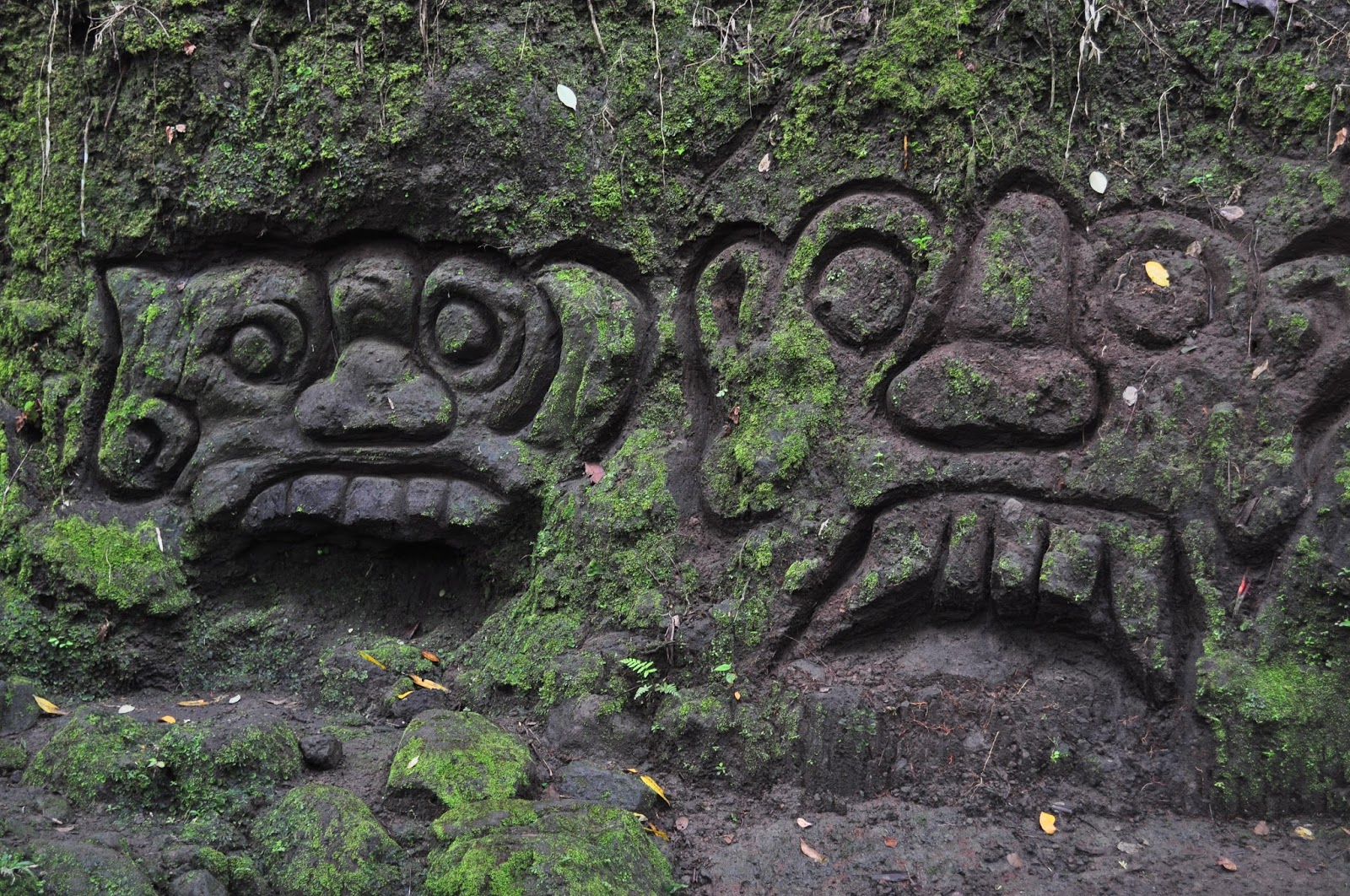


Like most famous sites in Ubud, it had lost a lot of its magic to the glut of inconsiderate tourists, but we discovered that there were other temples hidden in the jungle behind the main complex. We worked our way through the beautiful grounds and onto a muddy, narrow pathway that wound into the thick, torso-sized leaves guarding the Balinese rainforest.


"Torso-sized" was only a slight exaggeration
This is what greeted us

This pathway is narrower than it looks
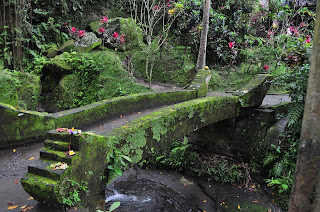
Most importantly, it looked like nobody else was going this way, making this much more of an adventure. I had a sort of Indiana Jones sense of exploration now, especially after passing more of these demon faces, which are very reminiscent of the beginning of “Raiders of the Lost Ark”. We slipped over wet, mossy rocks and traversed precariously narrow cliff-side pathways for a little over half an hour. Finally, we came to this bridge:


Look at that confident face


Of course, we crossed, and somehow survived. Eventually we found the temple, and watched some prayers, but didn’t sit around, thinking we had to trek back the way we came for another hour. Instead, as we rounded a bend, we found an Indonesian woman with a drink cooler and a pile of coconuts, as well as two children. Baffled at how she lugged all of this into the middle of nowhere (although we certainly appreciated the coconut), she explained that there was actually a staircase into the village about five minutes away. It turned out we weren’t as far from civilization as we’d thought, but we decided to ignore that fact, since we hadn’t seen another human in an hour and a half.

Also, we found the temple (near the stairs), which was much nicer to observe in this peaceful atmosphere than in the din of a hundred tour groups.


At the top of the stairs we encountered two other, smaller temples before ambling back to the motorbike and heading towards the Monkey Forest, where I didn’t dare take out my camera for fear of the primate gangs looking to extort anyone for a bunch of bananas. That’s really not a joke.

Monkeys are really funny to watch, especially around the people that didn’t read the signs and therefore attract their mischievous attention. We relaxed in a temple, talking about Indonesian dance styles (naturally) and watching other people have their food stolen or otherwise finding themselves in territorial disputes with the Macaques.

We eventually moved on, finding food and then meeting again with Maaike and Dewie to attend a Kecak performance. This one, designed in the 1930s, isn’t traditional, but is still supposed to be particularly visually impressive. For me, it just came off as a very touristy performance, without much quality and also lacking the spirituality and energy that is supposed to make up Balinese performances. It did provide this cool picture, though, where the dancer, with a giant “horse”, kicks flaming coconut shells around:

At this point, I still didn’t know where I would be the next day. Yan, Ana, Maaike and Dewie were leaving for Gili Trawangan early in the morning and since I lacked any other plans, they convinced me to join. So at 5:00 the next morning, with our bags (another reason to pack light) we took off through the Balinese countryside towards Padang Bai, the port from which we would begin the rest of what became a long, long journey towards the tiny island destination.

As much as I hate waking up early, it’s hard to rival watching Bali wake up from the back of a motorbike. Villagers had begun filling roadside markets, incense clouds from temple offerings thickened the air and the beginning sunrise between the mountains lit the rice paddies and countless Hindu statues with a brilliant gold. It almost brought to life the statues presiding over the center of village traffic circles.

We arrived with perfect timing for the early ferry, watching the low sun rise over the bay for the beginning of the five hour crossing from Bali to Lombok, the island one must pass through in order to reach the Gilis affordably. Taking advantage of the gentle rocking, cool breeze and pleasant company (we met up with Spain and Denmark at this point) we let our guard down for the transportation frustration what would greet us in Lombok.


Yan’s guidebook turned out to be fairly inaccurate in a very important place, claiming there were public busses from the ferry port to another harbor in the north, from which we’d have to take another boat to Gili. Either it is entirely wrong, or did not properly tell us where to find the bus stop, so we had to deal with the relentless bemo (minibus) drivers looking to give a ride.

This experience has further solidified my already firm prejudice against almost everybody in the taxi industry, as a cartel of drivers demanded exorbitant amounts of money for our ride. Eventually we had a reasonable price from one man, who ended up lying and dumping us halfway to our destination.

Our agreement had been to the Senggigi bus station, where we would take a public bus to the harbor. As we pulled into Senggigi, however, the driver told us that, by the way, there’s no bus station, or public bus for that matter, and that was too bad.

We had stopped in front of a bar, and had begun to argue loudly with him, because we were all very tired, and very pissed. By a stroke of luck, an adorable Kiwi woman who owned the establishment, flanked by two drunk Aussies (at noon), came out to help; she’d seen this situation before. This affable woman bestowed upon us an insider’s guide to arriving to Gili T much more easily than by the beaten path, saving the group from a collective breakdown.

We paid the first driver, even though he certainly didn’t deserve anything, found a second bemo for an acceptable price and piled in, despite the fact that it was held together by twine and zip ties. The minibus barely achieved the top of cliff-sides, and hardly held itself together as it rumbled down the opposite sides, and everybody felt carsick from the hairpin roads and exhaust fumes filling the back. This didn't matter, though, when we caught our first glimpse over the bluffs of the fabled sapphire and turquoise seas that draw so many bule from around the world.
A half hour of almost vomiting later, the minibus shuddered to a stop behind a row of “banana boats” (not the inflatable resort kind) that locals use for fishing and traveling among the islands. Our Kiwi guide had told us not to go all the way to Bangsal, the official harbor, but to negotiate a ride with one of these vessels. We found someone who was willing to take us aboard as he ferried his possessions to our island's next door neighbor, Gili Meno. As a result, we got a private boat ride across the beautiful sea that is so clear one can see shadows of the coral dozens of meters below the surface.In a way, the bemo driver's dishonesty was good, otherwise we would not have had this experience that most people pay for as a tour.
Chintia saved us
Abnormally green rock
Focus not on the sunburn but the clarity of the water
The unexpected and unplanned can be quite relaxing
Rooftop seating
Finally, an hour later, and twelve hours from our start in Ubud, we landed at Gili Trawangan. Since this wasn’t the boat’s final destination, he only nudged the bow into the sand of the “harbor” and we had to jump off the front onto the beach. The first four made it off without a problem, but I, with all of my stuff, leapt from the side as the boat slid from the sand and a wave rushed in. I landed unevenly and almost kept my balance, but after some flailing, I ultimately fell completely under the water for two long seconds.

Miraculously, despite soaking my entire being and completely submerging my backpack, nothing inside (such as my camera and passport) was the slightest bit damp. Even my iPod, in my shorts pocket, survived without a problem. Things, temporarily, were looking up.

That is, until the group split into its respectively booked hotel rooms, and I tagged along with Yan and Ana (I still had nothing anywhere at this point). It turned out that a reservation might not have mattered anyway, though, since my Balkan group and the European duo both arrived to their hotels to discover they had been double-booked and there was nothing the incompetent managers could do about it, even if they cared. During the peak season, which was this time, there are far more visitors than hotel rooms, so many people end up sleeping on the beach as punishment for coming to an isolated island at the same time as everybody else.

We were one of those groups.

We searched for an affordable room for two hours, passing sign after sign posted outside hotels with the fateful word "full" in bold letters slapping you in the face. All we obtained in this hunt was the adoption of a lone Swiss traveler who was dealing with similar luck. Eventually, everybody accepted that we would not sleep inside that night. After a somewhat melancholy dinner, we wandered the darkening beach, looking for a home, and found a set of lounge chairs in front of a hotel’s restaurant that nobody had cleaned up. Quickly, before surrendering them to the scores of other dejected, homeless foreigners wandering around, or to the hotel, all six of us grouped the seats together and spread ourselves over them.

The hotel employees did come out to clean up, but upon seeing us huddled across the chairs, they smiled pityingly and told us “ok, you sleep for free tonight, ya.” I was immensely relieved that nobody would kick us off the very comfortable beds we had claimed. At this point, I was even excited for our situation; we saved lots of money on lodging, and I had always wanted to sleep on the beach.

Because it was the last night of Ramadan, the island was almost silent that night. Instead of night clubs' thundering bass that supposedly usually rocks the main beach area, all we heard was the meditative Koran reading from the beachfront mosque. Much to my delight, there was a fireworks show across the channel on Gili Meno, and we had a perfect view. After, when everything had calmed down, the mosque's quiet chanting helped lull me to sleep.
We splurged on a sea view

Some went off rather close to us


I woke up in the morning to a bright red and pink sky, with the sun rising directly in front of us over the neighboring island. The beauty was startling and I immediately thought to grab my camera to save it forever. However, I had locked my bag with both my iPod and camera under the chair, and would have missed the sight trying to get a photo. Instead, I settled into my chair, claiming this beauty for myself. Until the actual orb of the sun popped above the horizon, I examined the brilliant, hot colors mixing above me. Maybe it was my half-doze, but I don’t remember seeing anything so vivid before.

Edit: I'm using this picture courtesy of Ana
This doesn't do it justice
Deeply content, I drifted back to sleep, then woke up to this:
Good morning, indeed
Also courtesy of Ana
So, being homeless for a night turned out not to be so bad. Most of us even felt very relaxed, so we lazily found a breakfast place, and as we saw waves of customers checking out of their rooms, began our room hunt anew. Within minutes we found a sufficient lodging for the best price we could get during peak season, and it was only 30 meters from the sea.

Secured in lodging (although the lounge chair was arguably much more comfortable than my bed), we spent the next two days lazing around in the beach and eating western food. While I was excited for it having eaten just Indonesian food for two months, I don’t understand why everybody who travels so far to reach the culturally rich Indonesia would want to encounter the same stuff from home instead of experience the local flavor. The thought bothers me now, but it was hard to hold on to it as I sipped delicious coffee with my feet in the sand and eyes on the sea.
It's distracting
On my third morning, I had to begin my journey back towards Java, as I was going to meet with the Tydif team in Banyuwangi for an outbound program. I spent the night in Munggu, the tiny village that houses the Bali IACS arts center. It was certainly too quick of a stop, since the area and arts community offer so much, but at least I got a quick glimpse of the real Bali outside of the tourism hubs, as well as a chance to see some other friends from the first week in Jakarta.

While this is far from my normal travel style (I like to go slow and spend a long time in one place), I doubt I could replicate this experience so successfully, and definitely not with this unique group. I certainly would never exchange these memories for any other experience.

What is most important about this experience is that, despite some periods of stress and exhaustion due to the long travel times, it was just about the essence of my idea of adventure. There were real challenges that would determine the outcome of my experience, and it embraced the excitement of the unknown by following such a nonexistant plan. It was a valuable learning experience in patience, negotiation, acceptance, endurance and teamwork, as we all really had to stick together in order to enjoy the ride, and definitely couldn't have done so alone.

Saturday, August 3, 2013

From My Computer Screen to the Indonesian Big Screen

In keeping with the trend of unexpected and random experiences in Indonesia, I have climbed to a new perch in what I now feel is a summit-less mountain of absurdity representing the experience of expatriates in this country: come December, I will be in a high budget Indonesian movie*.

* I’m just an extra in one scene, but they made sure to put all five white people very close to the camera to make it seem like we were everywhere

Regardless of my role, I couldn’t help but laugh, considering in the first twenty three years of my life, I had been in the newspaper maybe once, never (to my knowledge) on TV, and certainly hadn’t met any celebrities. In fact, apart from concerts, I haven’t even seen any in person. Not even Barack Obama, and I used to work about 200 meters from his house. All of that is entirely normal, too.

Now, in just two months in Indonesia, I have been in several Surabaya newspapers, appeared on  TV a few times, and also exist in at least a hundred people’s cameras, because it turns out I’m about as exotic as a celebrity. It only seems natural at this point to add to this list a day of brushing elbows (literally, actually) with celebrities and appearing, however briefly, on the Indonesian big screen.

I’m aware that extras aren’t important people in the grand scheme of things, and I won’t be famous from it, but it’s still something that very few people can experience, especially in another country, and ultimately in front of millions of people.

Everything started Wednesday morning (31 July) when Ucan, the up-and-coming director who essentially volunteers his time to coordinate our program, approached me asking if I wanted to help with a film shoot after our morning dance class. We would leave at noon and return sometime at night. The scene would be a 1920s Great Gatsby style party, and they needed about forty bule, because upper-class Indonesian parties during Dutch colonialism always had a lot of white people.

Everything about that was intriguing, so after dancing, Ucan, Leni (one of our photographers) and I ran to the car and started the ride to the film set. At this point, I still had no idea where we were going, having simply trusted Ucan that this wasn’t a kidnapping.
And who couldn't trust that face?

We rode for about three hours, towards Malang in the south, winding through narrow jungle roads and up steep, pot-holed hills, finally pulling up to a beautiful Dutch mansion from the early 20th century. Far up on a mountain, the air was crisp and clean. I inhaled deeply, relishing the first fresh air I’d encountered for some time. There were even birds singing in the trees! These simple things really don’t exist in Surabaya, and I’d been missing them painfully. All signs pointed towards another great adventure.

I managed to sneak a few pictures of the mansion’s exterior before some crew members forbade me from continuing:


Because I joined this with such short notice, I had sense of the movie (like its name) and therefore didn’t quite realize the magnitude of what I’d gotten into. While I stood about waiting for instructions, a guy in a well-tailored white suit sauntered past us without noticing our presence, and I thought nothing of it, but Ucan and Leni began to bubble with excitement, chattering in rapid Indonesian. It turned out that this was Reza Rahadian, who I roughly equate to being the Indonesian Brad Pitt. This is how I realized that this was a serious film, and not just a fun little project.

Eventually the casting director sent me to wardrobe, where they had to put me into a frumpy, mismatched suit, because I’m too tall for Indonesia and couldn’t put on any of the good clothes. They also told me they would slick back my hair for the 1920s effect, but never got around to that. I then waited some more, finding a group of bule who looked just as lost as myself. We soon discovered that, out of the forty necessary white people, we were the only five for the whole scene. This ultimately led to the producers placing us close to the cameras to make sure the party seemed full of “Dutch” revelers.

My fellow extras, from Serbia, Russia, Hungary and Argentina, had found themselves at the shooting in the same manner as myself: a last minute, circumstantial connection from a friend of a friend who knew somebody involved in the film. As we talked about our experiences in Indonesia, it became apparent that the expatriate experience here really is a series of crazy adventures that would never happen at home. It was oddly comforting to know that other people without any connection to IACS would have the same experiences and valuations as us. In a way, it confirmed that I am actually learning about Indonesian culture, in some form at least.

Despite arriving at 3:00pm, shooting didn’t start until after 7:00, because the scene takes place at night in an outdoor patio behind the mansion, so the crew had to wait until sunset, and then for 200 people to break their fast due to Ramadan. A major conclusion that I reached very early into the shooting is that I definitely would not want to be an actor, because it is a crushingly tedious experience, waiting for hours and repeating the same exact thing ten or fifteen times. Having so many extras made this especially difficult, because if one person messes up, everything starts over. With two hundred people, somebody is bound to do it wrong.

Thankfully, we never did. In fact, the producer even enjoyed us to the point where he occasionally hung out with us between takes.

Our job was fairly simple at first: slow dance like the other couples and have a generally good time while the main characters have a serious conversation in the middle. My “girlfriend” for the night was the Russian. Our “acting” was very easy since we were able to chat and joke around just as we would at a normal party. We just had to ignore the fact that there was a camera and Indonesian Brad Pitt five feet away.

This two minute shot took about two hours to film for many reasons. It was very exciting, however, when Reza, when he had to storm out, bumped into me, giving a truer sense to the phrase “rubbing elbows”.

Through other shots my Russian lady and I had to flirtatiously chat without actually using our voices, while roaming about the set around the camera. It’s surprisingly difficult to pretend to talk to someone without actually saying anything.

My favorite shot, which is also the one I most hope stays in the movie, is during a dance segment. The director told us simply to “be lively” without further instruction. Instead of chatting and fake flirting, my Russian partner and I decided to do our own dance. This is why I really want to be in this shot, because my infamously terrible dance skills can now be on display for millions of people. Whatever the filmmakers feel, I think it would be hilarious for the opening of the scene to include our awkward mixture of dancing styles to the side of professionally choreographed actors.

The shooting ended up lasting until sunrise, with the producers squeezing out every minute of darkness they could for the night scenes. We “acted” almost nonstop for about ten hours, with occasional fifteen minute breaks and one extended nap around 3am. It was also incredibly cold at only 15 degrees. Between takes I had to donate my silly looking suit jacket to my Russian partner, who was stuck in a strapless dress. Everybody was fairly numb by dawn, but we finished with dancing and the rising sun over the valley quickly thawed our spirits. My prediction had been accurate: it was an entertainingly ridiculous day. And night.

What I enjoyed most about the shooting wasn’t the celebrities or the fact that I’ll be on the big screen (pending editing) but that I got to share this experience with the other foreigners. We’ll never directly experience Indonesian culture just because we’re so different (white), but we still have valuable cultural experiences related to our strange, unique placement in Indonesian society. In my mind, it normalized the abnormality of our place and experiences in Indonesian society. The oddity of this is comforting and exciting in its own curious way.


Hopefully in the future I can obtain some pictures from the shooting to add in here

Friday, July 26, 2013

Soul Food for Thought

The idea of religion has always fascinated me. I’ve gone through various phases of “spirituality”, even though I’d say most of my younger phases ones involve thinking, just reactions to the then-tiny world around me. In the past couple of years I have thought long and hard about this divisive, unifying, terrifying and comforting idea that humans have created.

Most importantly in this philosophizing process is the realization that my beliefs and convictions have, and always will, evolve with new interactions, events and discoveries. As a result, I have concluded that becoming set in anything more than the most basic ideals inhibits personal growth, discovery and even happiness. This has mostly blocked out the possibility of me wanting to join any organized religion, specifically because of organization. And yet, these ideals share the very core of major world religions, so I still feel a strong connection to them.

For some time, this outlook made me think that I had to find a religion; some specific, shared outlook on the universe. I had convinced myself that I was lost, needing to attach myself to a system instead of floating around. Christianity and Judaism made up the vast majority of where I grew up, and neither connected with me at all. I had accepted Christianity as a de facto spiritual guide for some time simply because that’s what I grew up with, but knew it didn’t work with me and largely abandoned it towards the end of high school.

Lately, however, I have found joy in the freedom of floating around in my own path rather than finding one to stick to. This allows my ideals to evolve as necessary to account for new information and experiences around which I can adapt my beliefs rather than see things only as they fit a certain doctrine, which severely distorts reality and how to respond to life. This is where I have found freedom and serenity, creating a faith based on the challenges of the world.

An important detail of this is that it did not make me reject organized religion as a valid spiritual path for others. Rather, I have become more fascinated by all belief systems and how they compare, but mostly how they do provide so much for so many people. Despite plenty of experiences with those who practice as a result of indoctrination (which is not real faith to me) or just because they feel they have to, I have seen countless more who find true spiritual satisfaction in religion, really loving what they practice and believing it with their souls. This is a powerful uniting factor among belief systems, showing that at the core, following any of them is supposed to promote harmony and community among all creeds. The specific rules are up for interpretation (which is where people twist it the wrong way) but being a good human being is the purpose, and when people achieve this, they find that sense of peace that they can spread to others.

Now that I have lived in a very predominantly Muslim community for a month, though a far cry from understanding it, I’ve gotten a better sense of, and have even shared in, the spiritual satisfaction of an organized religion. The most profound sensations have been in relatively common practices rather than major events.

First comes with the ubiquitous call to prayer, five times a day. Our home stay in Surabaya is in close proximity to at least five mosques, so we hear a wide variety in song quality, which occurs five times a day (plus some bonuses during Ramadan). There are two singers, however, in whose voices one can hear true meditation and contentment. They work around the din of the atrocious singers from the other mosques, and after dinner their prayers float into the home stay on the breeze that kicks up with sunset, and the peace spreads to everyone who listens. Some of us have sat on the tiny balcony many times, taking in the sound, feeling its warmth and even its soul.

One evening, I listened to a particularly well-performed call to prayer with Mas Risa, the husband half of our cooks. The setting was perfect: a gentle breeze kept the mosquitoes and burning garbage smell away, and everything else was quiet. Somehow the usual din of city life was muted and the truly meditative state of the singer reached us clearly on the balcony, uninterrupted. Risa leaned on the railing with his eyes closed and half-smoked cigarette forgotten between his fingers. Already a generally relaxed guy, any remaining tension visibly evaporated, leaving a face and energy of pure serenity. When this mosque finished, and before the discordant cacophony of other mosques erupted, breaking this perfect calm, Risa turned to me, saying that hearing these prayers brought him a peace and happiness that he couldn’t really explain even in Indonesian. I believed it; I saw it, and even felt it myself.

Ramadan has played a big part in this, too. As I explained a couple posts ago, the purpose of this fasting month is a kind of spiritual cleanse, reminding followers to appreciate what they have and to practice self-control. I’ve so far survived two weeks (mostly) not eating or drinking anything between sunrise and sunset. Admittedly I have cheated twice and had a slice of peanut butter bread in the morning when I slept through sahur, the early morning last-chance meal (3:30 in the morning) before Indonesian Muslims must begin their fast for the day (4:00am; the time depends on sunrise, so people in the northern hemisphere have a longer fast).

Despite being tired and foggy during the day as I struggle to distract myself from hunger, I feel much more optimistic at night after eating three meals’ worth of food in an hour. Every night I convince myself that I can make it one more day, which will hopefully be a successful strategy in making it almost one month (not a full month because I’ll be in Bali for the final days, where I definitely won’t fast). Apart from my even greater appreciation for food (which I already really appreciated thanks to my wonderful mother) I feel like the fasting has influenced my attitude in some way. It’s not clear how, since during the day I’m still fairly hangry (hunger-cranky; not an Indonesian word). At night, though, things just seem… better. A large number of factors might influence this, but since it’s happening during the fasting, I won’t rule out the possibility.

This has helped me connect pretty deeply with everybody else who is fasting, partly by sharing in the misery, but also because of my joining in such a significant part of their lives. Every morning my conversations start like this:
“You’re fasting today?”
“Yeah…”
Bagus! (bah-goose; Good!)”
Taking part in traditions, especially spiritually significant ones, creates a bonding and learning experience that one cannot find from simply talking about it, just like the difference between reading about and traveling to a foreign land.

Because I have joined in on one tradition, it has opened the door to becoming part of a more intimately spiritual aspect of Ramadan: this past Friday (Muslim holy day, like Christians’ Sunday), the dance team and director invited me to stay after practice for buka puasa, or iftar in Arabic, which means breaking the fast. With this, they also invited me to join in their pre-dinner prayer, which surprised me considering I’m not Muslim.

The notion made me incredibly nervous, because I really didn’t want to mess up and accidentally insult them with some clumsy faux-pas. They would not have been insulted if I had passed, but genuinely wanted me to experience as much as possible and to understand part of the spirit behind their beliefs. I decided to go for it, keeping alert for every minute hand and body movement from the guys on either side of me. It turns out that it’s not very complicated, and I didn’t mess up, except regarding how I sat on my feet. Trying to teach me, thankfully, became a laughing matter rather than something serious.

I immediately made a connection between the prayers and meditation. There are very rhythmic chants and periods of reflective silence. One of the drivers turned to me afterwards and said that these prayers (which Muslims must perform five times a day) are kind of like yoga, which makes perfect sense; yoga, meditation and prayer share very similar goals of inner peace. Indeed, after we finished I felt the same peaceful and refreshing sensation that I occurred at various temples of myriad philosophies throughout Japan where I tried their prayers, as well as from my own occasional attempts at meditation.

Sharing this with my hosts made me feel closer to them and helped me spiritually. I have a better sense of certain aspects of organized religion, and also have managed to make even more connections across the spectrum of beliefs, bringing everything even closer together than before. Coincidentally enough, this all culminated later in the night when I watched “Life of Pi” which is a movie about a journey of faith. Its use of lofty movie dialogue gave me an articulation of this sensation that all of these faiths are interrelated, as well as the value of exploring all of them as deeply as possible.

Engaging directly with Islam here has helped me a lot. It has reinforced my decision not to join an organized religion, but has deepened my appreciation for those who do find spiritual enlightenment through this path. I also feel more at peace with myself by making these deep connections with the Indonesians and among different belief systems. While I can’t quite articulate how, I feel I have grown spiritually, and feel more at peace.


Indonesia continues to surprise me with what I've actually ended up learning..

Thursday, July 18, 2013

Breaking Storm

Sometimes, the simplest things can bring the most joy, such as a tropical downpour. While at home I generally associate the rain with cold and sogginess, here it brings a pleasant breeze and cuts the humidity, so at night the heat index is only 30 degrees instead of 34. And everything is already soggy from humidity anyway, so, there’s no difference there.


One rainy day in particular, a couple of weeks ago, turned out to be one of the most enjoyable days we’ve had in Surabaya, just from playing in a giant puddle. This was at the middle school where we have music lessons.

The day started off dreary and heavy, with low dark clouds concentrating the smog to a stifling level. We were in the midst of fighting hard to get a more balanced schedule, and many of us still suffered from heavy culture shock, so there was little motivation and tensions were fairly high. We danced in the morning, and the director of tourism paid us a surprise visit to see our sorely unprepared routines, further exacerbating frustration in the director, the choreographers and us.

Rumbling thunder outside, with the drenching sweat weighing us down seemed perfectly metaphorical for the building storm we felt would soon let loose. Both the physical and theoretical squalls were tangible in the classroom air when lunchtime rolled around. Thankfully our wonderful cook, Mbak Kiki, had a birthday, so we were able to distract ourselves by celebrating with her.

Ucan (oo-chan), the second-in-line-to-the-director-but-actually-does-the-work, brought in a delicious chocolate cake, lifting everyone’s spirits dramatically. After everybody got a piece, there was still plenty left over, so one of our more mischievous members started attacking faces with the icing. A cake fight quickly broke out and we eventually had plastered each other in chocolate war paint.

During this time, the sky finally opened up, letting loose a deluge that kept going. With that, we learned that the gutters had not been cleaned for a long time, because the overhang outside our classroom quickly formed a waterfall, and then the hallway filled up to our ankles.
Downstairs
Upstairs
One of the dancers and I went outside to wash the icing from our faces in the new sink, and started to lightly splash at each other. Jay, our instigative Fijian, saw, and decided to step up the game and began a full on water battle. Soon enough, there was uproarious splashing, slipping and sliding among a small group, and then we reached the cathartic moment when all but a few group members threw decorum to the wind and joined the fray, finally expressing the true sense of fun that hid beneath the false sense of order enforced by a certain higher power.
You'll notice Jay tends to be the center of the "mischief" (the guy with the blue shirt)


The child belongs to the cooks, don't worry
Some members held out, but we managed to (literally) pull almost the entire Tydif team outside with the help of Jay. Even the director’s husband and our drivers jumped in, starting a wrestling match and finding props to project the maximum amount of water onto others.


Few escaped unsoaked

This could not have come at a more perfect time. Looking back, it seemed like a fairly important tipping point that could have gone the wrong way. Thankfully the storm ultimately provided the opportunity to make things better, and have the tension cut in a positive way. Of course, since then we’ve had plenty of trials and frustrations, but the storm certainly pushed us in the right direction.